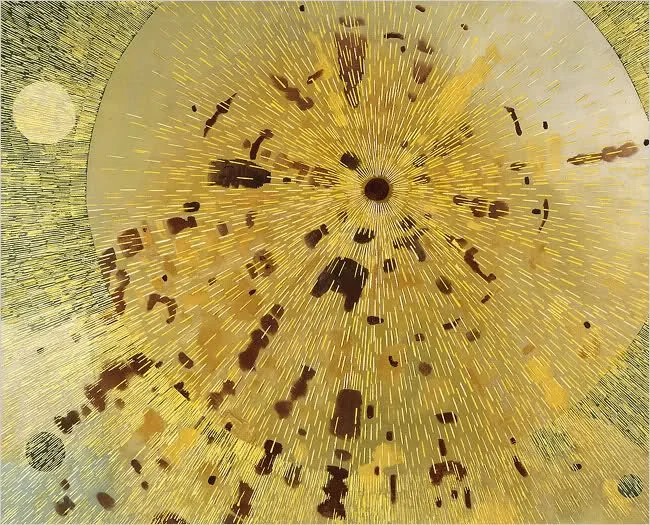
The Chart Describes a Myth

Lee Mullican
"Space"
40" x 50" oil on canvas, 1951

Astrological Nativity
a framework for seeing what we’re here to rise above.

Arrogance, accolades, exaltation, inferiority complexes, invisibility, detriment and fall, ego defenses, hang-ups, obsessions, triggers, triumphs. The whole chart can be understood as a kind of myth we are invited to transcend.

We are much more than the structure, symbolism, players, and texture of a chart. We express these things, but they are not the whole of us. In that sense the chart is a kind of mirage.

There’s an interesting parallel here with the Gnostic idea of the Archons: structures that can appear to govern reality when we mistake the structure for the whole of reality. The chart can become a kind of prison when we mistake its symbolism for who we are.

A birth chart can map the whole gambit: what we’re afraid to pursue but secretly long for, self-limiting beliefs, addictions, questions of worth and self-esteem, confidence, skillfulness, even projections placed upon us by others.

For instance, I’ve come to think of places like the 12th house very differently from the way they’re often treated, especially in traditional astrology. What has been feared, hidden, or pathologized can also point toward radical sovereignty, depth, and liberation. Jyotisha’s understanding of the 12th as a place of moksha speaks to this.

We ought to question the cultural assumptions, even colonized reasoning, behind some of this fear-mongering: what has been labeled dangerous, hidden, or undesirable, and why? Sometimes what is repressed is not weakness at all, but power. Hidden power. Power that has been pushed out of sight because it could not be easily controlled or understood.

Astrology is not a diagnostic tool, though it can help guide related inquiry. It should not be used to pathologize ourselves or anyone else. It can point to foibles, propensities, false constructions, and compensatory behavior.

Trauma-informed practice leaves room for each person to be an authority on their own experience. The chart does not explain a person. We are more than our charts. We are more than any lens through which a chart or framework might describe us.

Soul, or life force, is not the outer layer, structure, or story. We are whole. Spirit is beyond framing.

The chart may describe a myth.

And it is our story to write.

A strengths-based astrology begins here.

do no harm

Astrology must not be abusive. It is time we nip this in the bud.

Astrologers should not use any aspect of astrology to harm the people they serve, communicate with, or teach.

We need to stop minimizing this phenomenon. Astrologers can make damning assessments through essential dignity, house placements, geometric aspects, and other interpretive techniques. Astrology is, by definition, an interpretive and judgment-making practice: we analyze patterns and make delineations. But practitioners need to be more mindful about the sweeping, hierarchical, and sometimes harsh conclusions we draw from those patterns.

These conclusions do not simply disappear when a consultation ends. They can leave a residue. I have repeatedly encountered people carrying a lingering sense of shame about supposedly “weak” placements in their charts. What a waste of time. And what an unnecessary burden to place on another human being.

When dignity is used to allocate “goodness,” I cringe.

This has been referenced before. Consider, for example, the chart of Jeffrey Dahmer.

The point is not to use one person's chart as proof of anything, but to ask what we are actually doing when we assign moral or human value to planetary conditions. We should be extremely cautious about turning technical astrological categories into judgments about the worth or character of a person.

There is another issue here that deserves much more attention: we do not all use the same zodiac.

Millions of people practice astrology through another zodiac, in which a planet we have called “weak” may be exalted, or a planet we have called dignified may occupy an entirely different sign. If Jupiter is exalted in tropical Cancer, how can it simultaneously be considered in detriment in Gemini in the sidereal zodiac? What exactly are we claiming when two functional systems produce different assessments?

The existence and continued practice of multiple astrological zodiacs should complicate our certainty. We need to be talking about this.

And if dignity provides power, what kind of power are we talking about?

I am also concerned about the ways practitioners use astrology against themselves.

I see an overreliance on judgmental terminology — terms that are often used hierarchically to assign value, power, and praise: exaltation, dignity, strength. And on the other side: fall, detriment, exile. We should be more conscientious about what happens when these words become internalized as descriptions of the self. Words and concepts can cause real damage.

Why are astrologers and students of astrology playing this game with themselves and with one another? Why the impulse to measure and assess in order to determine superiority or inferiority? Where does that impulse come from?

These are important questions. Do we grapple with them enough? What is the actual impact—and cost—of repeatedly assessing ourselves and others through hierarchical systems of value?

I think students of astrology must wrestle much more seriously with their potential to do harm.

Can astrology be used to distinguish between better and worse luck? Perhaps. And if it can, is there something constructive that can come from thinking about luck, fate, and circumstance? Quite possibly.

Some people certainly are born with more luck. I am not saying that this is necessarily correlated with the chart. But some human beings are born into families where they are deeply wanted, appreciated, protected, and securely attached. That can affect virtually every aspect of their development and brain function. These people may go on to do very well in the world—and sometimes take a great deal of personal credit for achievements that were also made possible by circumstances they did not choose.

We ought to spend more time thinking about luck, fate, circumstance, and harm. We should also be asking what it means to live in a culture that often mistakes advantage for personal merit and struggles with humility. Robert Sapolsky's work is relevant here.

And what about context?

Reality. History. Poverty. Trauma. Systemic oppression. Family structure. Culture. Access to resources. Where does astrology come in here? And what does an unreliable system of dignity have to do with any of it?

Astrology can become another tool for oppressin —or applauding—someone who already lives with a set of circumstances that profoundly affects them.

If a person's internal system is oriented in a particular direction, an astrologer can easily reinforce what is already there, for better or worse. This is why we have to consider the actual person sitting in front of us, as well as the audience receiving our words.

Too often I hear from clients about practitioners who are profoundly insensitive. What they say lingers.

If you do not genuinely care about helping people, serving people, and being an uplifting presence, and if you are unwilling to develop a trauma-informed approach, you really have no business consulting with human beings.

I think there should be an almost paralyzing sensitivity around the responsibility to do no harm.

I hope that, in the near future, we see more thoughtful conversations about the very real possibility of using astrology to cause harm, whether intentionally or inadvertently. There is no need to stop practicing or studying astrology. But it is time to raise the bar on the kinds of freakishly simplified judgments we make, repeat, and participate in.

We can be more rigorous without being cruel.

We can interpret without humiliating.

We can acknowledge difficulty without turning it into fear-mongering predictions or shame.

And we can be much more intentional about how we choose to contribute to another person's understanding of themselves.

That seems like a worthwhile standard for astrology. And the only kind I’m interested in participating in.

Fergola, Salvatore, 1796-1874, lithographer, Public domain

A Similar Maleficence : Fred West

Preamble: I do not believe the planets, stars, or signs cause people to do horrific things. We cannot blame our chart for our problems. It is up to each one of us to decide how we will express and direct our energy and impulses. I believe there is a higher and lower expression to everything. The symbols do speak to and show where there may be difficulty - but it is often these very same influences that compel people to do the most interesting work.


Dahmer reverberates - 
Another horrible story.  

When I searched my database for another 'contrary to sect' Mars in Aries in the whole sign seventh house, I didn't come up with much - an athlete, an actor, a few others, sure...  However I was totally creeped out when I found an equally (to Dahmer) disturbing character, Fred West. He has not only the same basic signature (Mars Aries 7H) as Dahmer, but other shared degrees and sign placements. 

West, along with his wife, Rosemary, was a serial killer, rapist, zoophiliac, torturer, pedophile, incestual father, and all around general criminal. He likely suffered a brain injury in his teens (Aries rules the head, the battering ram, and is in opposition to his Sun in the whole sign first house of the body) - though this hardly explains the atrocities he committed as many suffer mild to extreme brain trauma and do not harm others.
 

Creepy, even as a child.

Creepy, even as a child.

The birth time on this chart is 'B' rated (from a biography), so there is a possibility it is not correct. I found it too curious however to see such sign similarities to Dahmer to not share.

In addition to the powerful out of sect malefic Mars in the seventh (Mars is generally less good for people who are born during the day), we see the signs: Taurus, Gemini, Virgo and Capricorn inhabited again, as was the case with Dahmer. Shockingly, if the time is indeed correct (though it's quite likely rounded off), they share the same zodiacal degree rising - the degree of the Sun at its maximum fall:  19+ Libra. 

Like Dahmer all the so-called (in ancient texts) "licentious, wanton, lecherous, and filthy sexed" signs are covered here. Capricorn again at the bottom of the chart, a house pertaining to death and burying the relatives under the family home (in very ancient times this was not a corrupt thing, but a place of burial for the ancestors) - and is exactly what he and his second wife maliciously did. Capricorn is inhabited by the Moon (its sign of detriment). The Moon (family, feelings, body, mother, the irrational) dominates Mars by square aspect - again, like Dahmer, Mars receives an aspect from a planet in Mars' sign of exaltation and seems to be empowered for the worse. And the Moon is in a superior trine to Saturn, the other malefic. Saturn (the almuten) an alternate ruler of the Ascendant is in Taurus (the Moon's exaltation) and sees the Moon occupying his own sign (Capricorn) while placed in the whole sign eighth house, another house of death. This is, once again, a lot of seeing and receiving between the three houses of death (4, 7, 8). See a previous post if you are scratching your head as to why these three houses pertain to death.  

Mercury and Venus are in Scorpio (a sign of detriment for Venus) and disposit to Mars. Mars is in fact the final or 'sole dispositor' of the chart. I find when a malefic is the sole dispositor [especially if it is the malefic of the sect not in favor = Mars, when the native is born during the day, and Saturn, if the person is born at night] that it can be quite problematic for a person, and extra care and conscientiousness must be worked on. 

And what about that grand trine in earth?  =  Moon  Saturn  Neptune 
Grand trines humorously garner a lot of attention for being a good thing - but it is entirely dependent on a) the planets involved, and b) the person's consciousness.
Reinhold Ebertin in The Combination of Stellar Influences has things (on the darker side) like this to say:

The sickness of the soul.. the inability to mature or develop emotionally.. a low character.. pessimism.. pathological states of depression..


Inner wheel: West
Outer wheel: Dahmer

One chilling point in the chart that compelled me to post is Rahu, the north node of the Moon and head of the dragon, it resides at 21+ Virgo the exact degree of Dahmer's north node in the twelfth house - a traditional house of imprisonment and self-undoing.  

If anyone has insights about this particular degree of Virgo, or other observations, please leave a comment. 


Curious Maleficence : Dahmer

Essential dignity is important. Yet I think it is easily misunderstood, overemphasized, or used willy-nilly without considering a lot of other factors. Assessing dignity [like most things in astrology] is complex. Some people will make a really big deal about a dignified planet, but dignity does not simply make a planet good. Dignity is also strongly altered by planetary aspects and receptions. 

In a very dark example, likely the darkest expression of the day, we see a so-called 'dignified' (in its own sign) yet 'contrary to sect' malefic, Mars, configured with the Moon in the place of the setting sun (7th house). Mercury, Venus, and Saturn as well are all in their own domicile (sign), and therefore have essential dignity.


Some technical gymnastics:

The Ascendant in Dahmer's chart rises in Libra at the degree of the Sun's deepest debility. The Sun is most exalted at 19 degrees Aries and is at its maximum fall at 19 Libra. I think this is an immediately important factor since it is a daytime chart (the Sun is above the horizon and so is the luminary of the sect in favor). The ruler of the Ascendant is Venus (the benefic of the sect not in favor - it prefers the night). It has 'power' in its own sign, Taurus, so it is good at getting what it wants, even if this is not particularly good for the native. It is in the 8th whole sign house, so it does not see the Ascendant. The 8th house is the traditional house of death. Venus is also rising before the Sun, and so is a morning star Venus, showing her more assertive and warrior-like face. Venus connects to Rahu, the head of the dragon (north node of the Moon), by a close trine aspect, but it is the sign of Venus' fall (Virgo) in the 12th house. The exaltation ruler (and almuten) of the Ascendant is Saturn in Capricorn (its own sign) in the whole sign 4th, giving a strong connection to and esteem for the parents and tradition. Also think of the 4th as pertaining to things buried, or deep under the earth. Saturn is, however, in a tight square aspect to the Ascendant, so we see potential for stress and blockage here. Houses 4, 7, 8 all pertain to death; in the 4th we return to the place from which we came, 7th is the setting place, and 8th is the experience of death, often not our own but the experience of death and upheaval around us (sometimes called a place of transformation). Also of note here, as all these places are highlighted, houses 4, 8, 12 according to the 13th century astrologer, Guido Bonatti, were thought to be houses of varying kinds of imprisonment.  

The Moon, luminary of the night sect (not the sect in favor), is waning and is right on the horizon, setting at the time of his birth. The Moon is configured in the whole sign 7th (traditional house of death = setting Sun) with the contrary to sect malefic, Mars, which is in its own sign Aries (making it strong, though potentially reckless). Moon (pertaining to body, nourishment, feelings, and the irrational) receives a dominating square from both Jupiter - which is debilitated in the sign of its fall, Capricorn, and is also the sign of the Moon's detriment - and Saturn, strong in Capricorn, but seeing the Moon in the sign of its own fall, Aries (which it does not care for). Mars receives these squares as well, and since Capricorn is the sign of Mars' exaltation, it is strengthened further (and apparently not for the better). Remember, strong does not equal good. Saturn sees Mars in this square and being the sign of its fall is not especially pleased. Mars is also the lord of the 7th house of partners and open enemies.

Mars severs, it is related to cutting and knives, it separates . . . 

Mars is also antiscia the moon's Node - a point symbolizing connections. Mars|Node can be work connections, physical, sexual, or athletic connections, connecting with men, or collaborative or quarreling connections. Mars can also sever or cut connections (Yikes!- when considered literally). Antiscia, being symmetry around the cardinal axis or Aries Point, is indicative of how we connect to the world. Dahmer connected via Mars|Node. Of course, a general Mars|Node connection means a lot of different things as noted, dependent on varied context and circumstance.

The Sun, the luminary for the day, is configured with Mercury, the lord of 9 and 12 and in the curious, dual sign Gemini. Mercury is a youthful and somewhat androgynous character, one that moves between worlds (the underworld and the earthly world). The primary trigon lord for Air signs in a day chart is Saturn, so both Sun and Mercury are tied strongly to Saturn at the bottom of the chart.
 

Chart set up from the Lot of Fortune. 
(Vettius Valens, a 2nd century astrologer, instructs us to use the Lot of Fortune as an alternate Ascendant.)


I read the chart from Fortune with whole sign houses, meaning: 0-30 Virgo is the 1st house, 0-30 Libra is the 2nd house, and so on. 


Pluto, lord of the underworld, rises with the north node, Rahu - the insatiable, hypnotic and deceptive head of the dragon. Neptune in 3rd - confusion and deceit in communication. Jupiter in its fall with Saturn in 5th - morally problematic pleasures and recreation; Venus' joy distorted. Chiron and Ketu, the tail of the dragon, indicative of loss, illusion, and wounding in the place of the other -the 7th. Moon and Mars - body and cutting and upheaval in 8th. Venus 'strong' in Taurus (strong for what? pursuing one's bodily desires? pursuing 'matter') and in the 9th, the traditional house of god and spiritual concerns; Dahmer's life was devoted to matters of the flesh. Of note here, Venus receives superior trines from both Jupiter (in its fall) and Saturn, in Capricorn; Capricorn is a notoriously lusty placement for Venus, and so due to the unimpeded flow (trine) it is highly affected by this influence. Sun Mercury in whole sign 10th - public image - Mercury in its own sign is receiving its only strong aspect from Mars, a superior sextile from the malefic contrary to sect. Mercury Mars is adept at handling tools, dissecting for instance [in his case, curiosity gone horridly awry]. Two faces, two places. Uranus in 12th - strange secrets. 

A brief interview with Dahmer. 

His father's perspective. 

This is of course a horrific example of a person with a serious mental illness. Astrology does not show that he is mentally ill, and it does not show that he would harm or kill people. It does show issues with emotions, parents, and others, but astrology does not say what a person will do or how conscious, conscientious, or aware they are. 

To recap, it seems clear that essential dignity does not make a planet good, it may make a planet good at getting what it wants, but this might not be good for others or for the person himself. Dignity does seem to strengthen a planet, but again that can be for better or worse. (Frida Kahlo for instance had an exalted Mars in the 6th (health, disease, accidents) and it was in partile opposition to her Sun in Cancer (the sign of Mars' fall) - it seems probable this powerful planet did more harm to her than it did good.)

One must look at the whole chart. Aspects relaying dignity or debility (called receiving and reception) seem to alter and affect things immensely, as does the way in which one chooses to direct and work with the energy.