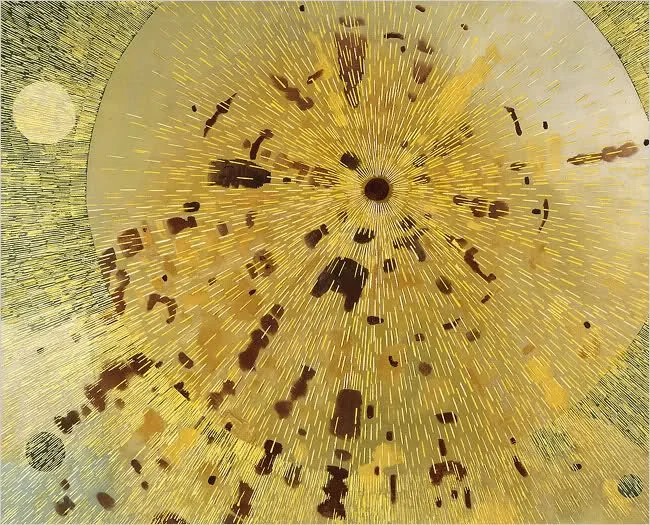
The Chart Describes a Myth

Lee Mullican
"Space"
40" x 50" oil on canvas, 1951

Astrological Nativity
a framework for seeing what we’re here to rise above.

Arrogance, accolades, exaltation, inferiority complexes, detriment and fall, ego defenses, hang-ups, obsessions, triggers. The whole chart can be understood as a kind of myth we are invited to transcend.

We are much more than the structure, symbolism, players, and texture of a chart. We express these things, but they are not the whole of us. In that sense, the chart is a kind of mirage.

There’s an interesting parallel here with the Gnostic idea of the Archons: structures that can appear to govern reality when we mistake the structure for the whole of reality. The chart can become a kind of prison when we mistake its symbolism for who we are.

A birth chart can map the whole gambit: what we’re afraid to pursue but secretly long for, self-limiting beliefs, addictions, questions of worth and self-esteem, confidence and skillfulness, even projections placed upon us by others.

For instance, I’ve come to think of places like the 12th house very differently from the way they’re often treated, especially in traditional astrology. What has been feared, hidden, or pathologized can also point toward radical sovereignty, depth, and liberation. Jyotisha’s understanding of the 12th as a place of moksha speaks to this.

We ought to question the cultural assumptions, even colonized reasoning, behind some of this fear-mongering: what has been labeled dangerous, hidden, or undesirable, and why? Sometimes what is repressed is not weakness at all, but power. Hidden power. Power that has been pushed out of sight because it could not be easily controlled or understood.

Astrology is not a diagnostic tool, though it can help guide related inquiry. And it should not be used to pathologize ourselves or anyone else. It can point to foibles, propensities, false constructions, and compensatory behavior.

Trauma-informed practice leaves room for each person to be an authority on their own experience. The chart does not explain a person. We are more than our charts. We are more than any lens through which a chart or framework might describe us.

Soul, or life force, is not the outer layer, structure, or story. We are whole. Spirit is beyond framing.

The chart may describe a myth.

It is our story to write.

A strengths-based astrology begins here.

the north node is not the path for everyone

image: Thomas Wright, An Original Theory or New Hypothesis of the Universe, 1750.

image: Thomas Wright, An Original Theory or New Hypothesis of the Universe, 1750.

There is a generalized interpretation of the lunar nodes in “western” astrology: that to move forward in one’s evolutionary journey one must follow the north node. This may be true — or it may not be. Culturally speaking there are big differences between the north and south nodes depending on astrology systems. Both are shadowy eclipse points. Both block light and have a smoky, shady, unclear quality about them. With Rahu (the north node) we find a hunger to acquire and / or possess, sometimes veering on insatiable. With Ketu (the south) there is a chronic dissatisfaction and irritation with imperfections pertaining to topics tied to its placement. One might call it divine discontentment.

Where Rahu resides there can be excessive materialism and materiality. Indeed, our culture still celebrates increase and acquisition at nearly any cost — no matter how destructive, underhanded, or essentially bad this may be for the native themself or others. Rahu does indicate where we are meant to stretch ourselves, explore the unknown. But we know to achieve success at one side of any polarity is never the whole story. Nor does it equate to a state of inner equilibrium or holism.

It could be said that to truly move along one’s path and evolve, we must achieve balance. With Rahu’s location in our chart we need to release fears and forge ahead anyway, while remaining mindful about going to extremes with blind and endless desires for: wealth-2nd house, family or happiness-4th house, partners-7th house, status and recognition-10th house, escape-12th house. In turn we may find, paradoxically, a state of peaceful surrender and total satisfaction specifically where and with what Ketu (the oft dreaded south node) represents: a quiet contentment with our self-1st house, family-4th, daily responsibilities-6th, partner’s contribution-8th, career-10th, and so on. This is why in the Indian tradition Ketu is associated with the path of liberation, resolution, or Moksha.

Food for thought….

If you know which houses Rahu and Ketu reside in your chart, does this resonate? Leave a comment if you like.

Sometimes letting things go is an act of far greater power than defending or hanging on. —E.Tolle